

Logistics sector training: how to become an industry professional
The transport and logistics sector interests you, but how do you actually get into it? What training do you need? Which driving licences do you need? In this article we go through the sector’s training paths clearly and practically.
The Vocational Qualification in Logistics
The most common route into the transport and logistics sector is the Vocational Qualification in Logistics (upper secondary vocational qualification), offered by vocational colleges around Finland. The qualification usually takes 2–3 years and can be started after comprehensive school.
In the Vocational Qualification in Logistics you learn the sector’s basic skills: handling vehicles, handling loads, the basics of logistics and safety matters. The studies include a lot of practical training, and many students gain a driving licence during their studies.
Once you’ve completed the qualification, you can find work as, for example, a driver, a warehouse worker or a logistics assistant. It’s a good foundation to build on.
Driving licence categories
In the transport and logistics sector, the driving licence is a key tool. Here are the most important categories:
Category B is the ordinary car licence. It allows you to drive small delivery vans.
Category C entitles you to drive a lorry. It’s the basis for heavy traffic and often the first step into professional driving.
Category CE is the licence for an articulated vehicle. It allows you to drive a tractor unit and trailer together. CE drivers are among the most sought-after in the sector.
Category D entitles you to drive a bus. It’s the basic requirement for a bus driver.
The driving licence is often obtained as part of the Vocational Qualification in Logistics, but it can also be gained separately at a driving school.
Professional competence (CPC)
A driving licence alone isn’t enough for professional driving. You also need the driver’s professional competence (CPC), gained through professional competence training. It covers 280 hours of training and includes, among other things, safety, fuel-efficient driving, legislation and health.
Professional competence is valid for five years at a time and is renewed through further training. This ensures drivers’ skills stay up to date.
Specialisation options
After basic training, you can specialise in the area you want:
ADR training is for drivers of dangerous goods. Tanker drivers need this qualification. Jaakko Aunio, a 23-year-old tanker driver, is a good example of a young professional who has specialised in this.
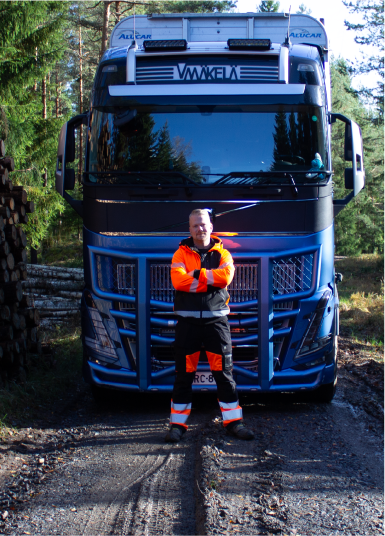
Timber haulage is its own specialist area. Timber lorry drivers need experience driving in demanding conditions and handling loads.
Public transport requires a category D licence and good customer service skills. A bus driver’s job combines driving with meeting people.
Further studies in logistics are possible for those who want to progress to, for example, logistics planning or supervisory roles. Universities of applied sciences offer logistics within an engineering degree.
Costs and funding
Vocational education in Finland is mostly free of charge. Students can apply for study grants and housing assistance from Kela (the Social Insurance Institution of Finland). Taking the driving licence as part of your studies is often cheaper than getting it separately.
If you’re already working and want to build on your skills, your employer may contribute to the training costs. Many haulage companies actively train their own drivers.
How do you get started?
The best way to start is to get to know the sector in practice. Work experience (TET) at a company in the transport and logistics sector gives you a first-hand picture of what the work is like. After that, it’s easier to decide whether you want to apply for the Vocational Qualification in Logistics.
On the Hyppää kyytiin website you’ll find TET placements from companies in the sector. In the videos, professionals from the sector talk about their own paths: how they got into the sector and why they enjoy it.
Frequently asked questions
At what age can you start the training?
You can apply for the Vocational Qualification in Logistics after comprehensive school, typically at age 15–16. Driving licences for heavy vehicles can be obtained from age 18 through professional competence training.
How long does it take to get a category CE licence?
The category CE licence can be obtained as part of the Vocational Qualification in Logistics, which takes 2–3 years. Taken separately it takes less time, but it requires a category C licence and experience.
Are you guaranteed a job in the sector?
The driver shortage is real, and the sector’s employment prospects are very good. Skilled workers have excellent chances of finding work straight after their studies.
Can you progress in the sector?
Yes. Many start as a driver and progress into supervisory roles, logistics planning or entrepreneurship. The sector offers varied career paths.
Find your own route into the sector
The training path into the transport and logistics sector is clear and well supported. If the sector interests you, the first step is to get to know it in practice.
Find a TET placement and try the sector yourself. It could be the experience that decides the direction of your future.
Muita kiinnostavia artikkeleita
How to organise a successful TET placement at a transport and logistics company? A practical guide for employers, from induction to safety.

What is a TET work-experience day like in transport and logistics? Explore varied TET placements and hear what professionals say about their jobs.

How do you become a professional in transport and logistics? Read about training paths, driving licences and professional competence.